Solar & Renewable Energy Systems
Connect every solar journey—from first lead to long-term plant service.
ENIGMA engineers digital operating systems for residential, commercial and industrial solar businesses—connecting sales, site surveys, design, BOQ, quotations, finance documentation, installation, commissioning and after-sales service.
Sales Control
Lead source, qualification, site visit and follow-up ownership.
Project Control
BOQ, approvals, dispatch, teams, quality and commissioning.
Service Control
Plant history, tickets, maintenance, warranties and support.
CommercialLead & qualification
Source · owner · follow-up
TechnicalSurvey & BOQ
Roof · load · design · pricing
ExecutionProject delivery
Material · team · milestone
LifecycleHandover & service
Customer · support · O&M
Customer journey
Enquiry → Survey → Quote → Install → Support
Single context
Selected Solar Project
Helium Solar — connected CRM and customer experience.
A solar EPC implementation where lead handling, sales activity, quotations, project coordination, customer visibility and operational follow-up stay connected as the customer moves from enquiry toward installation and service.
HS
SOLAR EPC & RENEWABLE ENERGY
Helium Solar CRM
A CRM environment for a solar EPC business where lead handling, sales activity, quotations, project coordination and operational follow-up remain connected as the customer moves from enquiry toward installation.
Business systemCRM & EPC Operations
crm.heliumsolar.in
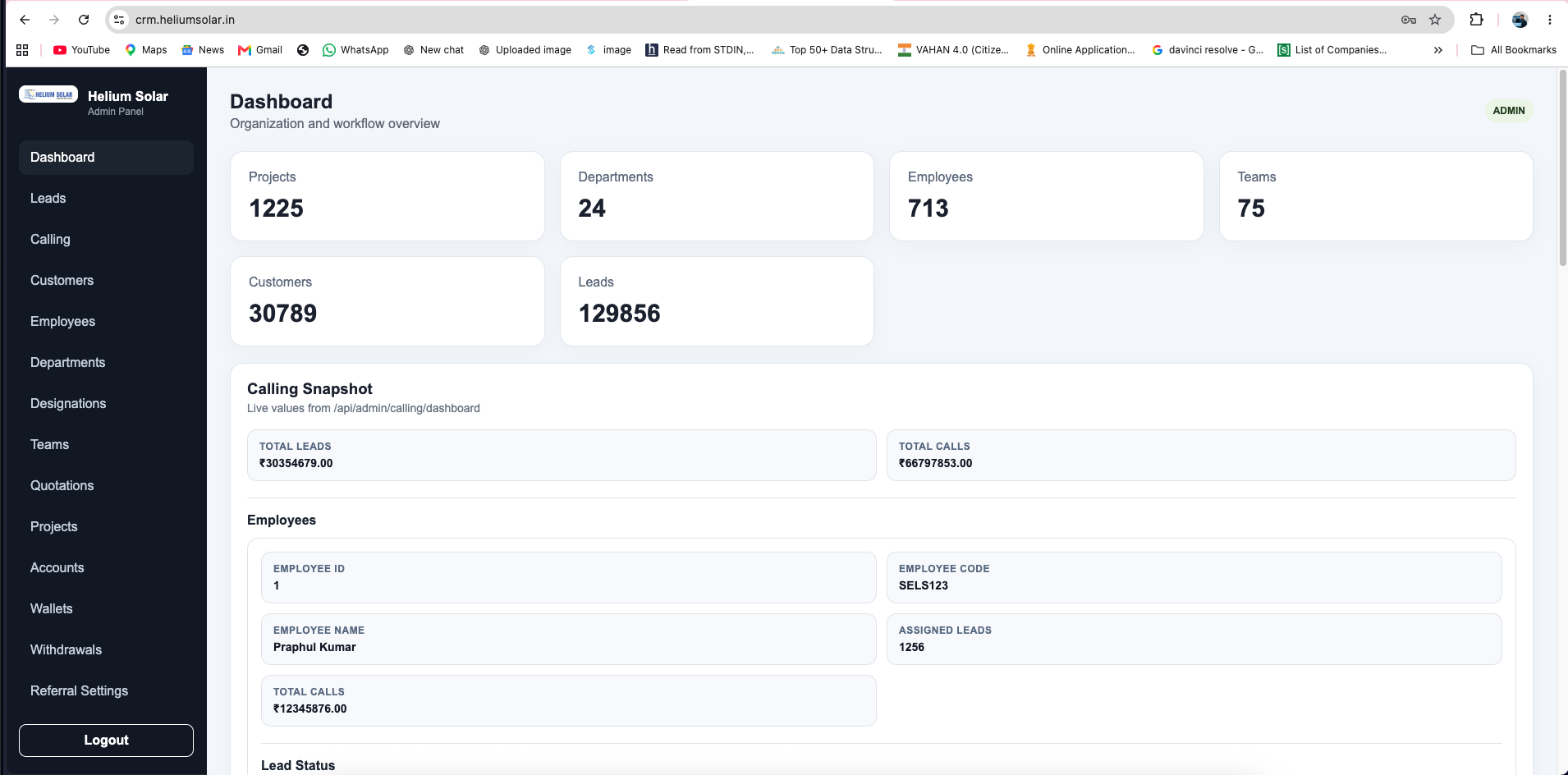 View
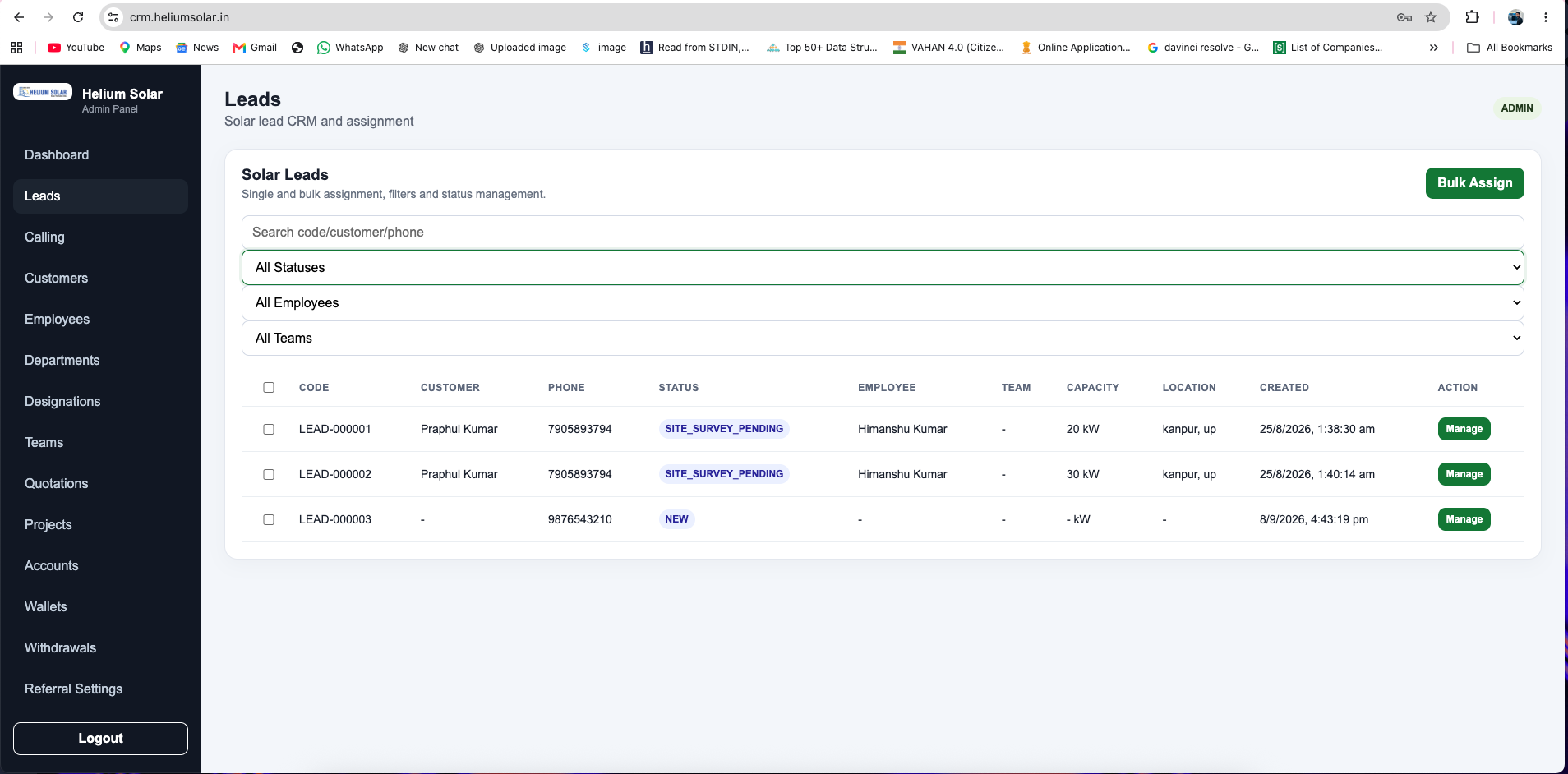 View
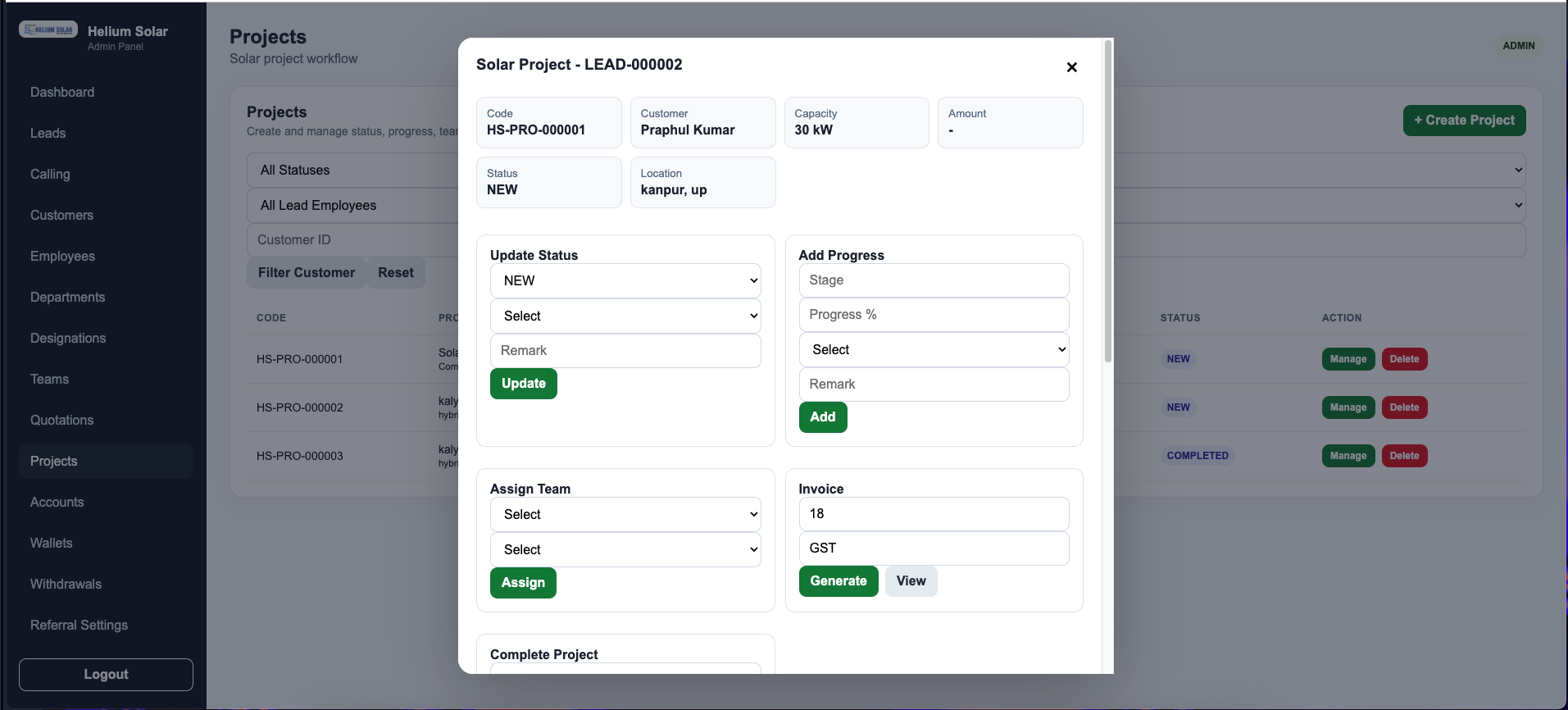 View
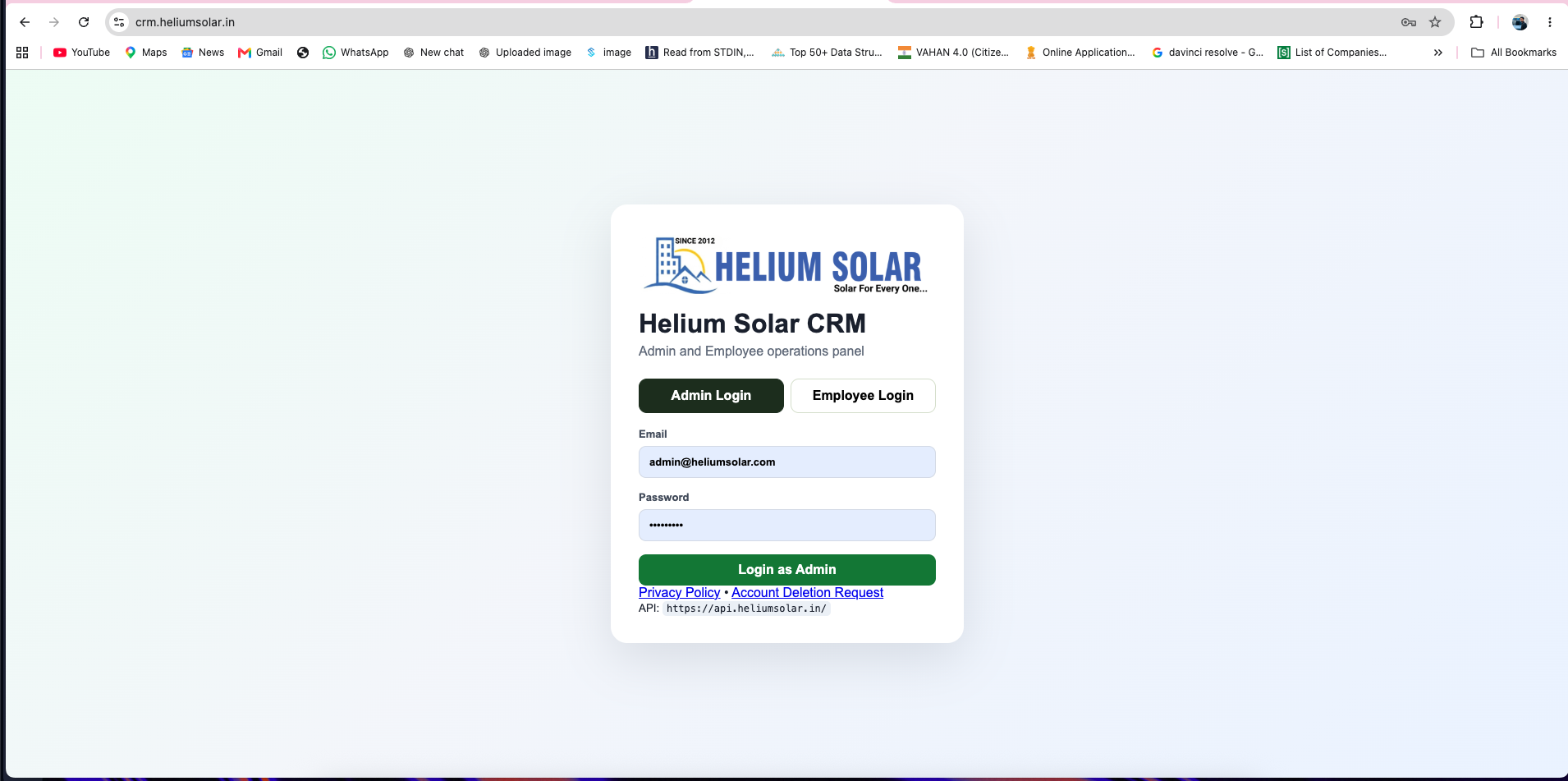 View
Published Android application
Helium Solar Customer
View on Google Play ↗
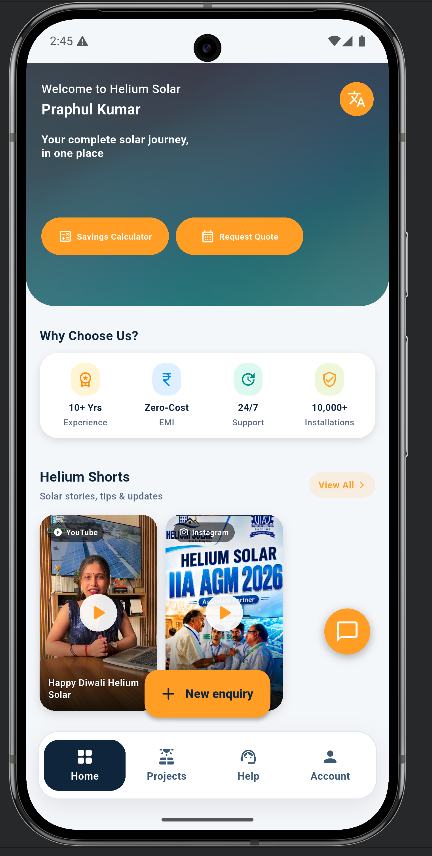
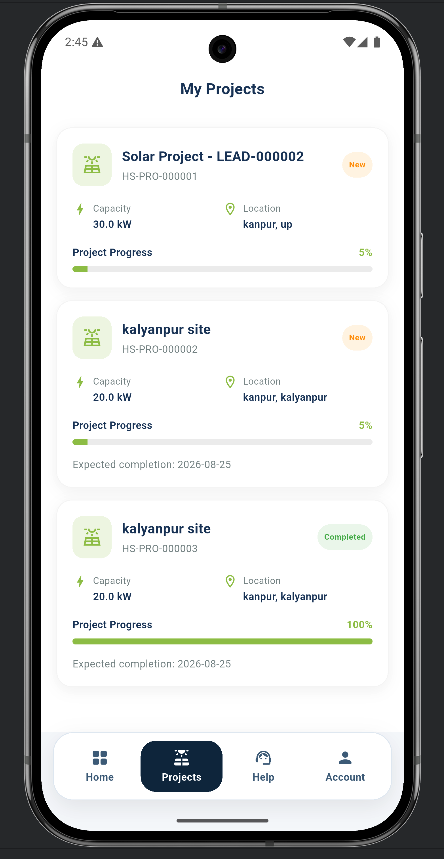
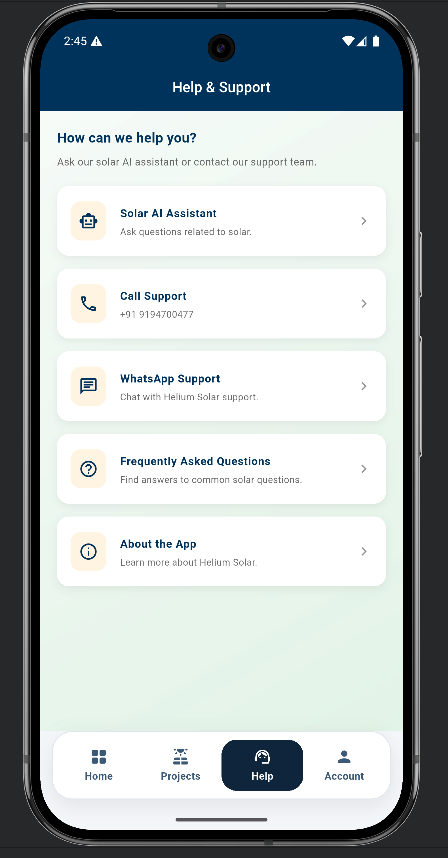
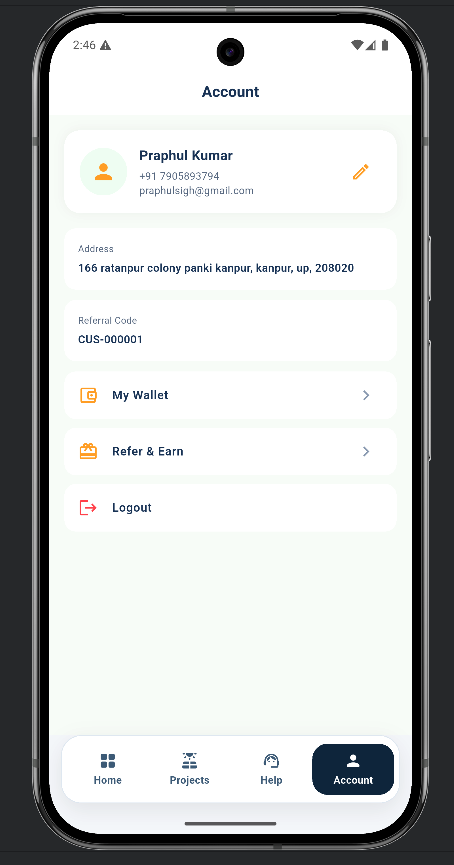
A customer app for solar project tracking, account information, referrals, rewards and wallet visibility, solar content, savings information, support and FAQs throughout the solar journey.
 View
 View
 View
 View
▶Customer app walkthroughPlay video
✓
Connected product ecosystem. CRM operations and the customer application represent two sides of the same solar journey: internal teams manage sales and project execution while customers stay informed through a dedicated app experience.
Solar & renewable energy systems by ENIGMA
How ENIGMA structures a connected solar operating platform
Revenue operations: lead source, qualification, ownership, follow-up, site visit, quotation and conversion history.
Technical workflow: survey evidence, load data, roof information, design, BOQ, pricing and approvals.
Project execution: procurement, material dispatch, team assignment, installation milestones, commissioning and handover.
Customer lifecycle: project visibility, referrals, rewards, support, service history and O&M context.
Selected implementation: Helium Solar CRM and Helium Solar Customer app demonstrate connected internal and customer-facing solar workflows.
Selected Solar Organizations We Support
Sector experience grounded in operating businesses.
Technology relationships are shown without invented performance metrics or undisclosed client outcomes.
Solar EPC Organization
Helium Solar
Residential, commercial and industrial solar operations with installation, financing and long-term service requirements.
Technology services supported by ENIGMA
Solar Engineering Business
Sun Solar Solutions
Residential, commercial and industrial solar journeys covering consultation, survey, design, installation and monitoring.
Digital platform and technology services by ENIGMA
The Operating Problem
Solar growth becomes difficult when sales, engineering, execution and service operate in separate systems.
A missed survey detail can change the BOQ. An unapproved material substitution can affect execution. A disconnected customer history can weaken after-sales support. The platform must preserve context across the entire plant lifecycle.
01
Lead Leakage
Enquiries from campaigns, referrals, calls, WhatsApp and field teams lose ownership or follow-up context.
02
Survey Inconsistency
Roof, load, structure, shadow, photographs and documents are captured differently by every surveyor.
03
BOQ & Quotation Delay
Engineering inputs, pricing, approvals and branded proposals move through disconnected files.
04
Material Blind Spots
Procurement, warehouse dispatch, site consumption, returns and substitutions are not connected to the project.
05
Execution Visibility
Management cannot see team allocation, milestone delay, quality evidence and commissioning readiness in one view.
06
Service Fragmentation
Plant documents, warranty history, complaints, visits and O&M activity are separated from the customer record.
Operational Capabilities
Different solar teams, one shared project and customer history.
The system can be configured around the organization’s segment, geography, finance model, approval structure and execution method.
Revenue Workflow
Turn every enquiry into an accountable solar opportunity.
Capture channel source, customer profile, electricity requirement, ownership, next action and conversion history without losing context.
✓
Campaign and referral leads
✓
WhatsApp and call integration
✓
Lead scoring and assignment
✓
Follow-up and visit scheduling
✓
Residential and C&I pipelines
✓
Conversion and source analytics
Technical Workflow
Standardize site evidence before design and pricing.
Give field teams a controlled survey format and pass approved technical inputs directly into design, BOQ and quotation workflows.
✓
Load and bill analysis
✓
Roof and shadow observations
✓
GPS, photos and documents
✓
Structure and site constraints
✓
Survey approval and revision
✓
Design and BOQ handoff
Project Delivery
Control material, teams, milestones and quality.
Connect commercial approval with procurement, dispatch, installation scheduling, site evidence, quality checks and commissioning readiness.
✓
Project plan and milestones
✓
Team and contractor allocation
✓
Material dispatch and returns
✓
Installation evidence
✓
Quality and safety checklist
✓
Commissioning and handover
Commercial Control
Make finance and documentation dependencies visible.
Track quotation approval, payment milestones, loans, subsidy documents, net-metering activities and commercial exceptions around the project lifecycle.
✓
Quotation version control
✓
Approval and discount limits
✓
Payment milestone tracking
✓
Loan document workflow
✓
Subsidy status tracking
✓
Net-metering dependencies
Plant Lifecycle
Preserve context after installation.
Create a service record linked to customer, plant, components, warranty documents, commissioning evidence and previous support activity.
✓
Asset and component history
✓
Warranty and document vault
✓
Complaint and ticket workflow
✓
Technician scheduling
✓
Preventive maintenance
✓
O&M and performance follow-up
Leadership Control
See conversion, execution and service from one operating view.
Give leadership role-appropriate dashboards without fabricating a single universal KPI model for every solar organization.
✓
Lead source and conversion
✓
Survey and proposal ageing
✓
Project milestone visibility
✓
Material and cost exceptions
✓
Service response history
✓
Branch and team performance
System Architecture
A solar platform should connect field activity, commercial rules and plant data—not create another isolated dashboard.
Experience Layer
Customer, sales, survey, installer, service and management web or mobile experiences.
Identity & Workflow
Roles, branches, approvals, ownership, escalations and controlled state transitions.
Business Services
CRM, survey, BOQ, quotation, projects, inventory, finance, service and reporting.
Integration Layer
ERP, payments, communication, document, maps, IoT and monitoring integrations.
Data & Governance
Audit history, secure documents, master data, backups, monitoring and operational controls.
Illustrative Workflow
A residential rooftop project moves forward only when commercial, technical and documentation checkpoints are ready.
This example demonstrates a possible operating pattern. It is not presented as a fabricated client result.
The exact stages, approval rules, subsidy process and finance dependencies are configured according to the organization and applicable programme.
01
Lead qualification
Customer requirement, location, bill profile, source and owner are recorded.
02
Survey assignment
Field survey captures roof, load, photographs, GPS and required documents.
03
Engineering approval
Approved data generates design inputs, BOQ and commercial quotation.
04
Finance readiness
Payment, loan, subsidy or net-metering dependencies are tracked.
05
Execution release
Material, installer, schedule and quality checklist are controlled.
06
Commissioning & service
Handover creates the plant record, warranty context and service lifecycle.
Connected Ecosystem
Solar operations often depend on systems outside the core workflow.
ENIGMA designs an API and integration model based on the systems already used by the organization and the reliability of available third-party interfaces.
Finance & Payments
Payment gateways, accounting, lending workflows and collection status.
ERP & Inventory
Purchase, stock, dispatch, project consumption, returns and reconciliation.
Communication
WhatsApp, SMS, email, calling, reminders and customer notifications.
Plant Monitoring
Inverter, IoT, telemetry or monitoring data where supported by available interfaces.
Maps & Field Services
Location, routing, geotagging, visit evidence and technician operations.
Documents & Signatures
Bills, KYC, agreements, approvals, drawings, warranties and e-sign flows.
Marketing Platforms
Campaign sources, forms, landing pages and conversion attribution.
Data & BI
Management dashboards, operational exports and governed analytics datasets.
Engagement Deliverables
A complete solar operating-system engagement—not only a CRM screen.
Scope is selected after workflow discovery. Not every organization needs every module on day one.
Solar Workflow Blueprint
Current-state process, roles, approvals, documents, exceptions and target operating model.
CRM & Lead Operations
Channels, pipeline, ownership, follow-up, site visits and conversion history.
Survey & Engineering System
Field capture, evidence, approvals, revisions and handoff to BOQ/design.
Project & Installation Control
Milestones, teams, material, evidence, quality, commissioning and handover.
Finance & Documentation Workflows
Quotations, approvals, payment, loan, subsidy and net-metering status.
Service & Plant Lifecycle
Asset history, warranties, support, technician visits, maintenance and O&M.
Role-based Dashboards
Operational views for sales, engineering, project, service, finance and leadership.
Integration & Rollout
API connections, migration, testing, access controls, training and phased adoption.
Engineering Process
Implementation begins with the solar operating reality—not a fixed industry template.
01
Workflow Discovery
Map lead sources, survey practices, engineering decisions, execution and service responsibilities.
02
Rule & Data Design
Define project stages, master data, approvals, documents, permissions and exception handling.
03
Architecture & UX
Design web, mobile, integration, security and reporting architecture around actual users.
04
Build & Integration
Engineer modules and connect the approved external systems and communication channels.
05
Migration & Validation
Clean critical data, validate workflows, test roles and run realistic operating scenarios.
06
Rollout & Improvement
Launch in phases, train teams, observe adoption and improve controls using real usage.
Frequently Asked Questions
Questions solar leaders ask before connecting their operation.
The system can be configured for residential rooftop solar, commercial and industrial EPC, solar products, franchise or dealer networks, field-service teams and O&M operations.
Yes. Website forms, campaigns, call-centre activity, WhatsApp, referrals, franchise channels and field leads can enter one controlled sales pipeline with source attribution and ownership.
Yes. Survey teams can capture roof details, load information, photographs, GPS, documents and technical observations. Approved survey data can then support design, BOQ, quotation and project planning workflows.
Yes. Eligibility, document collection, application status, approval checkpoints, disbursement dependencies and net-metering activities can be configured around the applicable business process.
Yes. The platform can connect project schedules, teams, contractors, dispatch, site material, installation evidence, quality checks, commissioning and customer handover.
Yes. C&I workflows can include bill analysis, decision-maker tracking, feasibility, technical design, proposals, approvals, procurement, project milestones and O&M handover.
Yes. The architecture can connect CRM, ERP, inventory, finance, payment, communication, document, IoT and plant-monitoring systems through APIs and controlled data exchange.
No. ENIGMA maps the actual operating model first and then engineers the modules, permissions, integrations and reporting required by the solar organization.
Solar Workflow Discovery
Let’s map how your solar business sells, surveys, engineers, installs and supports every plant.
Begin with your actual teams, documents, approvals, delays and integration landscape. The resulting architecture will be specific to your operating model.